Ship auth and billing for your MCP server today. Not next week.
OAuth 2.1, API keys, Stripe metering, rate limiting — wired together and working. The part nobody ships.
One-time payment. No subscription. No revenue share. You own the code.
See it in action (67 seconds)
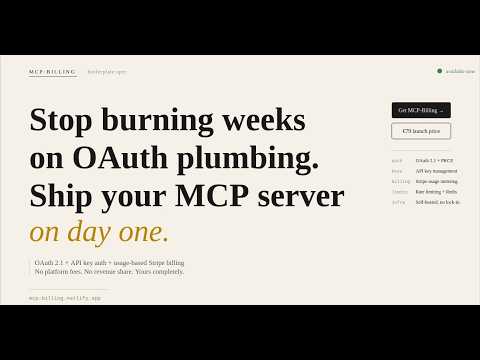
Real output, MCP-Billing v1.0.1 — OAuth flow, API key lifecycle, webhook idempotency, quota and rate limiting all covered.
The problem
Building the MCP tool takes a weekend. Wiring identity and payments around it doesn't. This is a common story from builders shipping MCP servers in 2026:
— Real developer, r/mcp
Why now
What's in the box
- auth
OAuth 2.1 + PKCE
Your server accepts standard OAuth clients without you touching a single RFC.
- keys
API key management
Generate, rotate and revoke keys from the dashboard in one click.
- billing
Stripe usage-based billing
Charge per call, per token, whatever you want. Retries, partial failures and interrupted streams — explicit handling included, documented with code examples.
- limits
Rate limiting with Redis
Protect your server from abuse without writing a sliding window algorithm.
- multi
Multi-tenant ready
Each MCP server client gets its own context, keys and quota.
- infra
Independent from your server
Don't couple billing to your logic. It's infrastructure, not product code. Change your MCP server without touching billing.
The billing decisions nobody talks about
Usage-based billing gets interesting once you have retries, partial failures, and streamed responses. These three decisions are already made for you.
- retry
Retries never double-charge
Every usage event carries an
idempotencyKey. Same key twice, billed once.await recordUsage({ idempotencyKey: req.headers['idempotency-key'], endpoint: '/tools/search', status: 'completed', }) // same idempotencyKey again → 200 OK, not billed twice - partial
Partial failures aren't billed by default
A call that dies mid-way is recorded with
status: "partial", not sent to Stripe unless you say so.await recordUsage({ idempotencyKey, endpoint: '/tools/search', status: 'partial', // client disconnected mid-call }) // logged for audit — excluded from billing by default - stream
Streaming bills once, at the end
One usage event per completed stream — not one per token.
stream.on('end', () => recordUsage({ idempotencyKey, endpoint: '/tools/search', status: 'completed' }) ) // interrupted mid-stream → status: 'partial', same rule as above
How these decisions were made in practice — and where the only one still open is → full write-up on Dev.to
Want the full decision reference these came from — idempotency, streaming, and the webhook out-of-order trade-off that isn't in the public write-up? Free, straight to your inbox.
Free: the metering pattern, extracted
The idempotent metering pattern above — dedup by idempotency key, a commit boundary, partial/failed handling, a configurable billing policy — is also published separately as mcp-metering, a free, open-source (MIT) npm package. It's built for MCP servers that are already in production: drop it in as middleware around what you've already shipped, no rewrite required.
It does not include auth, OAuth, API keys, quota management, rate limiting, or Stripe integration — that's the full boilerplate below.
npm: mcp-metering · source on GitHub
Install it, read the code, and decide if the rest of the engineering is worth paying for. It's proof of quality, not a cut-down teaser.
Pricing
≈ $90 USD · charged in EUR
One-time payment. Full source code. Commercial license — unlimited personal and client projects. Resale of the boilerplate itself not permitted.
Buy now — €79 →7-day refund if it doesn't work in your environment.
FAQ
Q: Do I need to understand OAuth 2.1 to use this?
A: No. Everything is pre-configured. Add your environment variables and deploy.
Q: What if Stripe changes its API?
A: The code is in your repository. You control the updates.
Q: Does it work with any MCP server or only certain frameworks?
A: It works as an independent layer. Your MCP server calls the auth and billing endpoints — framework agnostic.
Q: How does it handle retries and interrupted calls in billing?
A: Each usage event carries an idempotency_key. If the same event arrives twice (network retry), it's only charged once. Interrupted calls are recorded as 'partial' and you decide whether to charge them — documented with code examples.
Q: Is support included?
A: Yes — I respond to GitHub issues for 60 days from purchase. Built by Marc Gil · Dev.to
Q: Can I use it in client projects?
A: Yes. Unlimited use license. You cannot resell the boilerplate itself.
Q: Is there a refund policy?
A: Yes — 7-day refund if the code doesn't work in your environment and I can't fix it via GitHub issues. No questions asked within that window.
Q: Why not just ask Claude Code to build this?
A: You can — that's literally how this was built, with Claude Code as a pair programmer from day one. Writing the first draft was never the hard part. Early on, a webhook handler here returned the same 400 status for an invalid signature as for a transient database error — which meant Stripe never retried, and billing events could silently vanish. Catching that is the actual work: the code is cheap to generate now, the decisions and the tests that pin them down aren't. Check that level of detail yourself before paying: mcp-metering is free and open-source — install it, read it, judge for yourself.
Still deciding? Get the billing edge-case reference free.
Ready to ship?
Get MCP-Billing and have auth + billing running today.
Buy now — €79 →One-time payment · No subscription · Commercial license